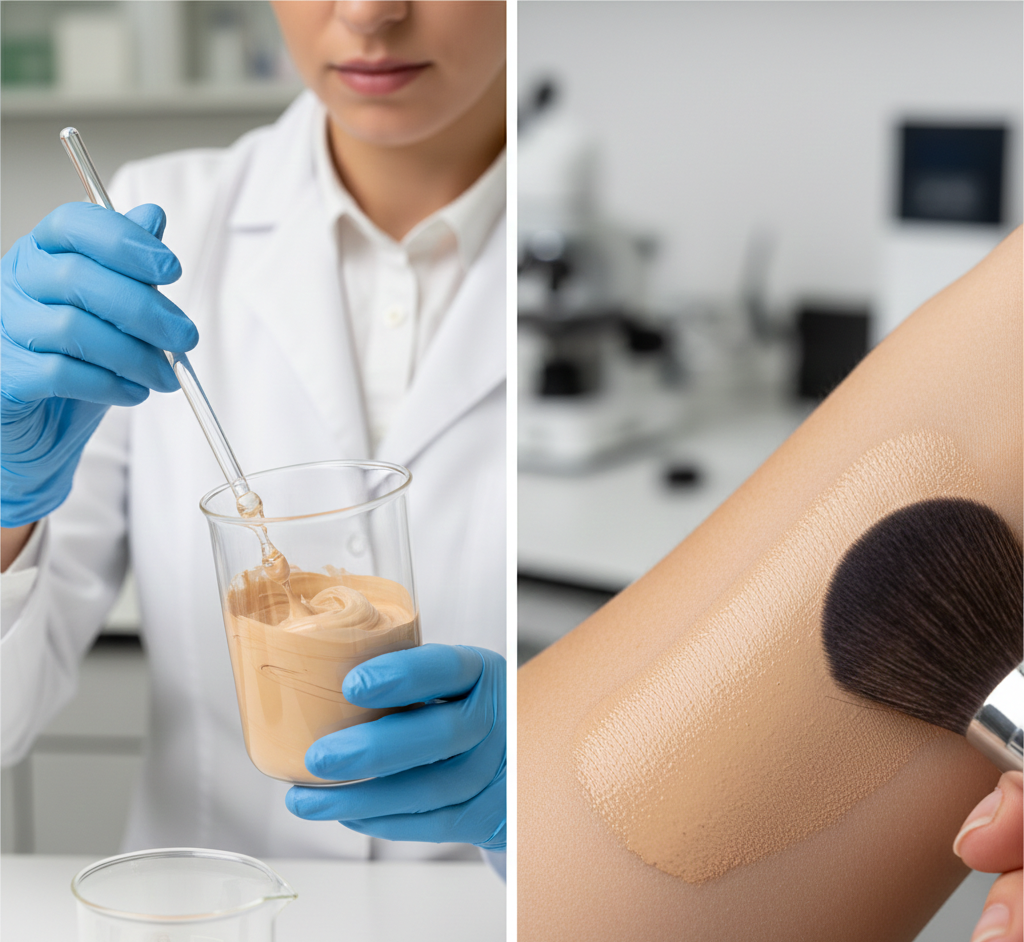
In liquid foundations and liquid lipsticks, the battle is always between "coverage" and "cakeyness." The solution isn't adding more oil—it's using low-viscosity silicones to wet pigments more effectively.
1. The Pigment Wetting Challenge
Iron oxides and Titanium Dioxide are difficult to disperse. In traditional ester-based formulas, these pigments tend to agglomerate (clump together), leading to streaky application and settling in fine lines.
Low viscosity Dimethicones (5 cSt - 20 cSt) possess significantly lower surface tension (~20 mN/m) than vegetable oils (~32 mN/m). This allows them to penetrate pigment clusters, separating particles for a true-to-tone, smooth color payoff.
2. Engineering "Long-Wear"
Why do some foundations last 12 hours while others slide off in 2? The answer is often Volatility Rate.
By using a volatile carrier like SHINESIL™ CPS S2 (Cyclopentasiloxane), the formula spreads easily during application. Once applied, the D5 evaporates, leaving behind only the film formers and pigments. This "setting" action locks the color in place, preventing migration.
The Soft-Focus Effect
Combining SHINESIL™ DM 350 with silica powders creates a "blurring" effect. The silicone fills micro-crevices in the skin, while the powder scatters light, creating that coveted filter-like finish.
3. Formulation Guide: Liquid Lipstick
For a matte liquid lipstick that doesn't crack, try this ratio:
- 40-50% Volatile Carrier: Cyclopentasiloxane (SHINESIL™ CPS S2) for rapid drying.
- 10-15% Film Former: TMS or Resin blends.
- 5-10% Plasticizer: Dimethicone 350 cSt (SHINESIL™ DM 350) to keep the film flexible so it moves with the lips instead of cracking.
4. Conclusion
The difference between a luxury foundation and a budget one is often the quality of pigment dispersion. Switching to a high-purity, low-viscosity silicone chassis ensures that your color cosmetics look as good at 8 PM as they did at 8 AM.